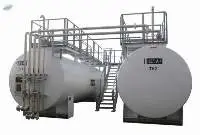
Product Description : Virgin Fuel Oil D6 is a heavy residual petroleum fuel obtained from the final stage of crude oil refining. It is a high-viscosity fuel primarily used in industrial boilers, marine vessels, furnaces, and power generation plants. The fuel requires preheating before pumping and combustion.
Appearance : Dark brown to black viscous liquid
Typical Key Specifications
Parameter Typical Value
Density @15 C : 0.94 - 1.02 kg/L
Viscosity @50C ; 180 - 380 cSt (grade dependent)
Flash Point : >66C
Sulfur Content : 0.5- 3.5% (depends on grade and regulations)
Water Content : 1.0%
Ash Content : 0.1%
Carbon Residue : High
Pour Point : 24 - 30C
Calorific Value : 39 - 42 MJ/kg
Jet Fuel A1 is available through a direct mandate with a Kazakhstan refinery and title holder. The product is non-sanctioned and supplied in accordance with international aviation fuel specifications for commercial and private aviation use.
Jet A-1 Aviation Turbine Fuel is a premium-grade aviation fuel designed for use in commercial aircraft, cargo aircraft, military aviation, and turbine-powered aviation equipment. Produced and tested according to international aviation standards, Jet A-1 offers excellent combustion efficiency, thermal stability, low freezing point, and superior performance under varying climatic conditions. The product is suitable for international aviation operations and is supplied through approved refinery and terminal networks with complete export documentation and third-party inspection support.
D6 is a type of residual fuel, mainly used in power plants and larger ships. The fuel requires to be preheated before it can be used. It is not possible to use it in smaller engines or vessels/vehicles where it is not possible to pre-heat it. D6 is its name in the USA. In other parts of the world, it has other names.
Residual means the material remaining after the more valuable cuts of crude oil have boiled off. The residue may contain various undesirable impurities including 2% water and one- half percent mineral soil. D6 fuel is also known as residual fuel oil (RFO), by the Navy specification of Bunker C, or by the Pacific Specification of PS-400.
NSRIC Green Supplies Inc. (NGS) is your trusted, licensed intermediary for the global sourcing and distribution of Marine Fuel Oil (MFO). In the high-stakes environment of maritime logistics, a consistent and reliable supply of compliant MFO is non-negotiable for fleet operators and bulk purchasers.
We specialize in connecting verified end-sellers with legitimate end-buyers, eliminating transactional friction and mitigating supply chain risks. NGS facilitates MFO trade that adheres strictly to international compliance standards, including the latest IMO regulations. Our expert team manages the intricate documentation, logistics, and secure financial settlements to ensure every MFO transaction is transparent, profitable, and delivered on schedule.
Whether your requirement is for residual fuel oils compliant with specific sulfur caps or general bunker supplies, NGS guarantees access to quality products at competitive international rates. Partner with us to achieve operational excellence and secure your MFO supply chain with unparalleled confidence and efficiency.
Fuel Oil is a fraction obtained from petroleum distillation either as a distillate or a residue Broadly speaking oil is any liquid petroleum product which is burned in a furnace or boiler for the generation of heat or used in an engine for the generation of power except oils having a flash point of approximately 40 C 104 F Oil is made of long hydrocarbon chains particularly alkanes cycloalkanes and aromatics The term Fuel Oil is also used in a stricter sense to refer only to the heaviest commercial fuel that can be obtained from crude oil heavier than gasoline and naphtha
Fuel oils are used as fuel for power generation marine bunkers and large industrial heating plants Fuel oil 180 CST also known as Bunker Fuel or Residual Fuel Oil is characterized by its viscosity which is measured in centistokes CST The number 180 indicates the maximum viscosity of the oil at 50 degrees Celsius This specification makes it a relatively thick and viscous fuel compared to lighter fuel oils Both CST 180 and CST 380 fuel oils are considered heavy fuel oils and are commonly used in the shipping industry They are often referred to as bunker fuels and are used in vessels like cargo ships container ships and oil tankers
Virgin Fuel Oil D6 is a high-quality, refined fuel oil commonly used in industrial and power generation applications. Known for its excellent combustion efficiency and energy output, it provides a reliable and cost-effective solution for large-scale heating and energy production systems.
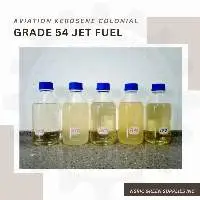
Grade 54 Jet Fuel is a high-performance aviation fuel specifically designed for use in turbine-engine aircraft. It offers excellent fuel efficiency, reliability, and safety, ensuring smooth and safe operation under various weather and flight conditions, while meeting international aviation standards.
Original Jet A1 Fuel is a high-performance aviation fuel designed for use in turbine-engine aircraft. Known for its excellent combustion properties, it ensures safe, efficient, and reliable operation of aircraft, meeting international quality and safety standards.
The full name of Jet Fuel A1 is the aviation Kerosene Colonial Grade 54 Jet Fuel JP 54 Jet fuel designed for use in aircraft powered by gasturbine engines It is clear to strawcolored in appearance The most commonly used fuels for commercial aviation are Jet A and Jet A1 which are produced to a standardized international specification Jet fuel is a mixture of a large number of different hydrocarbons The range of their sizes is restricted by the requirements for the product for example the freezing point or smoke point Kerosenetype jet fuel has a carbon number distribution between about 8 and 16 carbon numbers carbon atoms per molecule wide cut or naphthatype jet fuel including Jet B between about 5 and 15 carbon number Jet A1 is the standard specification fuel used in the rest of the world Jet A1 has a flash point higher than 38C 100 F with an autoignition temperature of 210 C 410 F
Jet A1 is a� kerosene-type fuel. Jet fuel or aviation turbine fuel is a type of aviation fuel designed for use in aircraft powered by gas-turbine engines. It is colorless to straw-colored in appearance. The most commonly used fuels for commercial aviation are Jet A and Jet A-1, which are produced to a standardized international specification. During the refining process only 8% of the crude oil is made up of Jet fuel.
High-grade turbine fuel meeting ASTM D1655 and AFQRJOS standards for global aviation operations.
Ensures optimal engine performance with strict freezing point and purity controls.
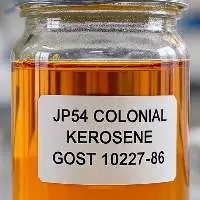
JP54 Colonial Kerosene is Russian Aviation Kerosene Colonial Grade 54â?? to GOST 10227-86. Itâ??s a jet fuel grade, but NOT an official international spec like Jet A-1.
JP54 is a military-grade aviation turbine fuel derived from kerosene. It originated as a specification used by the military and is closely related to jet fuels used in aircraft turbine engines.
What Does JP54 Mean?
JP stands for Jet Propellant.
JP-4 and JP-5 were historical military jet fuels.
The term "JP54" is widely used in commodity trading circles, but in practice most commercial aviation fuel traded internationally today is Jet A-1.
JP54 Colonial Grade 54 specs (GOST 10227-86)
Comparison with Jet A-1.
Type: Kerosene-type aviation turbine fuel. Same family as Jet A-1
Color: Orange to straw-colored liquid Jet A-1 = clear/straw
Density: @15C** 776 - 840 kg/m Jet A-1: 775-840 kg/m
Flash Point: 38C min, 42C max Jet A-1: 38C min
Freeze Point: -40C max Jet A-1: -47C max - this is the big diff
Sulfur: Total 0.30% wt max Same as Jet A-1
Aromatics: 22% vol max Jet A-1: 25% max
Smoke Point: 19mm min Jet A-1: 25mm min
Net Heat/Energy: 18.4 MJ/kg min Jet A-1: 42.8 MJ/kg min
Additives: Antioxidant 17-24 mg/L, Static dissipater ASA-3/Stadis 450 Similar to Jet A-1
Key Characteristics
Property: JP54
Fuel Type: Aviation Turbine Fuel
Base Product: Kerosene
Main Use: Jet aircraft and turbine engines
Appearance: Clear to straw-colored liquid
Energy Content: High energy density
A large number of online "JP54" offers are not associated with actual aviation fuel transactions. In legitimate international aviation fuel markets, buyers typically contract for Jet A-1 that meets recognized standards such as ASTM D1655 and DEF STAN 91-91.
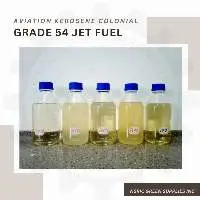
We are trading in - Aviation Kerosene Colonial Grade 54 Jet Fuel JP 54
Aviation Kerosene Colonial Grade 54 Jet Fuel JP 54: Jet fuel A-1.Jet fuel designed for use in aircraft powered by gas-turbine engines. It is clear to straw-colored in appearance. The most commonly used fuels for commercial aviation are Jet A and Jet A-1 are produced to a standardized international specification. Jet fuel is a mixture of a large number of different hydrocarbons. The range of their sizes is restricted by the requirements for the product, for example, the freezing point or smoke point. Kerosene-type jet fuel has a carbon number distribution between about 8 and 16 carbon numbers (carbon atoms per molecule); wide-cut or naphtha-type jet fuel (including Jet B), between about 5 and 15 carbon number. Jet A-1 is the standard specification fuel used in the rest of the world. Jet A-1 has a flash point higher than 38 C (100 F), with an autoignition temperature of 210 C (410 F).
Russian JP54 is an abbreviation for Jet Propulsion, A1, Colonial Grade 54. During the refining process only 15% of the crude oil is made up of JP54 the rest of the grade is used for different types of plastic. Developed by JP Morgan, Colonial grade JP54 was replaced by AVGAS also known as AVGAS100LL.
Actually most jet fuel exported from Russia is JP54 or Colonial JP54. It is similar to Jet A except the the Specific Energy is 18.4 mj/kg compared to that of 42.8 mj/kg of Jet A.
Premium-quality Jet Fuel A-1 manufactured in compliance with international aviation fuel standards. Jet A-1 is a kerosene-type aviation turbine fuel with a low freezing point and excellent combustion characteristics, making it suitable for commercial airlines, cargo operators, military aviation (where applicable), and private aircraft. The fuel is produced under stringent refinery quality control and supplied with complete export documentation, including Certificate of Quality, Certificate of Origin, Refinery Test Report, SGS inspection (upon request), and other shipping documents. Available for bulk supply under CIF, FOB, and TTO procedures.
Wheat Flour Specifications:
PROPERTIES VALUES & LIMITS
Product Name: Wheat Flour
Color: Creamish White
Moisture: 13% Max
Protein: 11% Min
Ash: 1.20% Max
Moisture: 13% Max
Dry Gluten: 8% Min
Wet Gluten: 25% min
Packaging Details:
TYPES OF BAGS QUANTITY
PP Bag 25 / 50 KG in New PP Bag
- As Per Customer Requirement
Container Capacity:
TYPE OF CONTAINER QUANTITY
20' FT Container 23-24 Metric Tons
40' FT Container -
Wheat Flour Benefits and Uses:
Wheat flour is used for a variety of dishes like roti, bread, paratha, sheera, pasta and noodles.
Wheat flour can also be used to make healthy pizza bases.
High in nutrients and fiber.
Lower your risk of heart disease.
Lower your risk of stroke.
Reduce your risk of obesity.
Lower your risk of type 2 diabetes.
Bunker Bed All Tips Single Size Metal Bunk Bed
2-Step Iron Bunk Bed, Space Saving Design, Ideal for All Ages,
Durable Mild Steel Frame, Board, Easy to Assemble