Supplier From
Tianchang,
Anhui,
China
Supplier From
Tianchang,
Anhui,
China
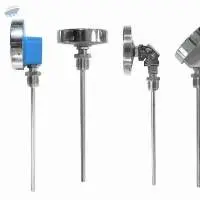
The core of a bimetallic thermometer is a spiral or helix-shaped bimetal element made of two metal strips with different thermal expansion coefficients welded together. When the temperature changes, the two metals expand differently, causing the element to twist and rotate the pointer via a shaft, indicating temperature directly on the dial. The entire process is purely mechanical, requiring no batteries or external power, and never fails due to a power outage. With no electronic components, it is immune to electromagnetic interference, making it suitable for use near variable-frequency motors and high-voltage switchgear. The response speed is moderate, sufficient for most industrial on-site temperature monitoring needs. Compared to glass thermometers, it is much stronger and less prone to breakage. Compared to thermocouples, it requires no transmitter and is more cost-effective.
The thermowell, connection, and housing of the bimetallic thermometer are typically made of 304 or 316L stainless steel, resistant to water, oil, weak acids, alkalis, and steam corrosion. Thermowell diameters range from 6mm, 8mm, 10mm to 12mm, with lengths customizable from 50mm to 2000mm. The housing protection rating reaches IP65 or IP66, dust-tight and protected against water jets or even brief immersion, suitable for outdoor or humid workshop installation. Connections between housing and thermowell include threads (G1/2, G3/4, NPT1/2, etc.) and flanges (DN25, DN50, etc.), with reliable sealing to prevent leakage. The housing can also be filled with silicone oil or glycerin to enhance vibration resistance, ideal for high-vibration equipment such as compressors, pumps, and engines. The fill fluid also prevents fogging inside the dial, keeping readings clear in alternating hot and cold environments.
The bimetallic thermometer offers a wide variety of temperature ranges, including common ones such as -40~+80C, 0~100C, 0~150C, 0~300C, 0~500ºC, with custom low-temperature extension to -80C. Accuracy classes are typically 1.0 or 1.5, meaning permissible error of ±1% or ±1.5% of span, meeting the requirements of most industrial on-site monitoring. Dial diameters include 60mm (compact), 100mm (general purpose), and 150mm (long-distance reading), with white background/black markings, and some models feature red alarm zones. The pointer can be designed with an external zero-adjustment screw for easy field calibration of zero error. For export equipment, dual-scale dials (C/F simultaneously) are available to suit different national habits. Additionally, electrical contacts can be added to output a switching signal when the temperature reaches a high or low limit for alarm or interlock control.